
WMCA: Preparing the West Midlands for a changing climate
Climate Adaptation Study
West Midlands Combined Authority (WMCA) is looking to reach net zero carbon emissions by 2041, in line with their Environment & Energy Programme. They had recently developed a plan for increasing the region’s ability to adapt and overcome the risks associated with a changing climate. WMCA wanted to increase their understanding of potential future scenarios and identify financing options to maximise the positive impacts for its communities and businesses.
Project
Accelar utilised our expertise in data analysis to quantify different climate change scenarios, projecting parameters until 2100. We also generated GIS maps to visualise the potential risks and impacts. We then developed funding models for potential adaptation approaches. Accelar worked with SWM to present the scenario analysis and related suggestions in a highly accessible plan, for use of local residents as well as WMCA.

“We have all seen the alarming frequency and intensity of extreme weather events in recent years which only serves to confirm the importance of adapting to the changing climate.
Our #WM2041 net zero commitment demonstrates our level of ambition when it comes to mitigating the impact of climate change. As part of our devolution deal discussions with Government, we’re seeking more funding and responsibility in order to establish a regional framework that will help to coordinate climate adaptation activity – working with local communities to co-create the solutions we need.”
Services
The Accelar team:
Conducted stakeholder workshops and gathered information from public and client-owned sources, then used this to develop climate change analysis for different scenarios.
Projected impacts and risks across the West Midlands region, developing a risk matrix for each climate scenario.
Communicated findings in a high level summary, highlighting the scenarios, impacts and risks most likely to affect WMCAs residents, infrastructure, businesses and natural environment.
Identified gaps in data and mapping and what may be required for further investigation, and suggested how the datasets could be interrogated further to gain a clearer picture.
Developed adaptation financing and funding models, proposing contextual implementation recommendations in relation to the climate scenarios projected.
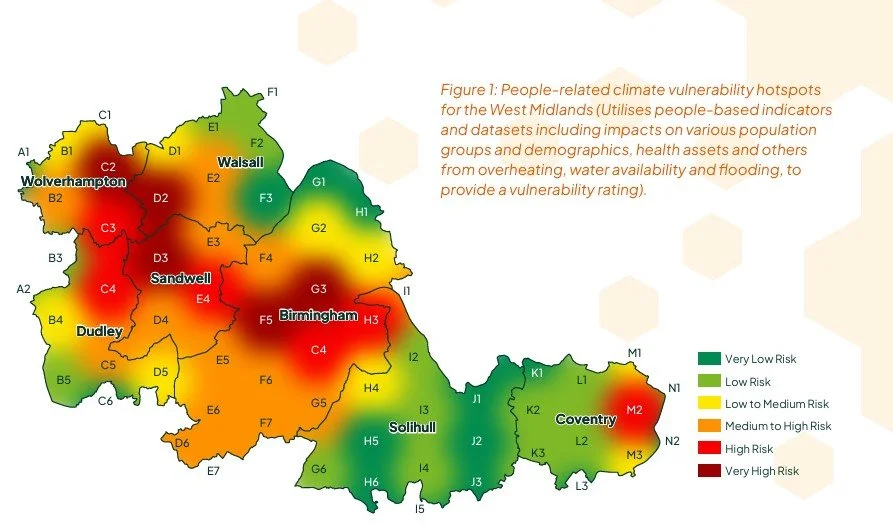
Climate vulnerability hotspots map