
£42 Million for Farmer-led Project to Recover River Adur
Accelar is proud to have supported the Adur River Recovery project since late 2024, working closely with the project team and land managers to develop the blended finance strategy, business model and 30-year financial model underpinning the project’s long-term delivery. We are delighted to see the project meet this major milestone and move closer to its 30-year vision to recover the River Adur and mitigate impacts of climate change.
Our work has involved translating ambitious plans across 760 hectares and 27 farms into a financially sustainable proposition, connecting habitat restoration and outcomes including improved river-floodplain connectivity, biodiversity, water quality, natural flood management, carbon storage and more resilient farming with appropriate sources of public and private finance. At the heart of our work has been bringing together public funding with opportunities from biodiversity uplift, woodland carbon and the emerging opportunity for saltmarsh carbon, alongside exploring the role of private investment.
A major part of our role has also been taking the proposition to market. Accelar has supported extensive buyer engagement, working with prospective buyers, market intermediaries and potential partners to test market appetite, understand buyer requirements and develop credible routes to market for the project’s ecosystem services. Alongside this, we have worked extensively on investor engagement and financing options, exploring how repayable private capital could complement public funding and nature-market revenues
Together, this work has helped shape a long-term blended finance proposition that combines public funding, nature-market revenues and private finance, while supporting the project’s progression towards implementation.
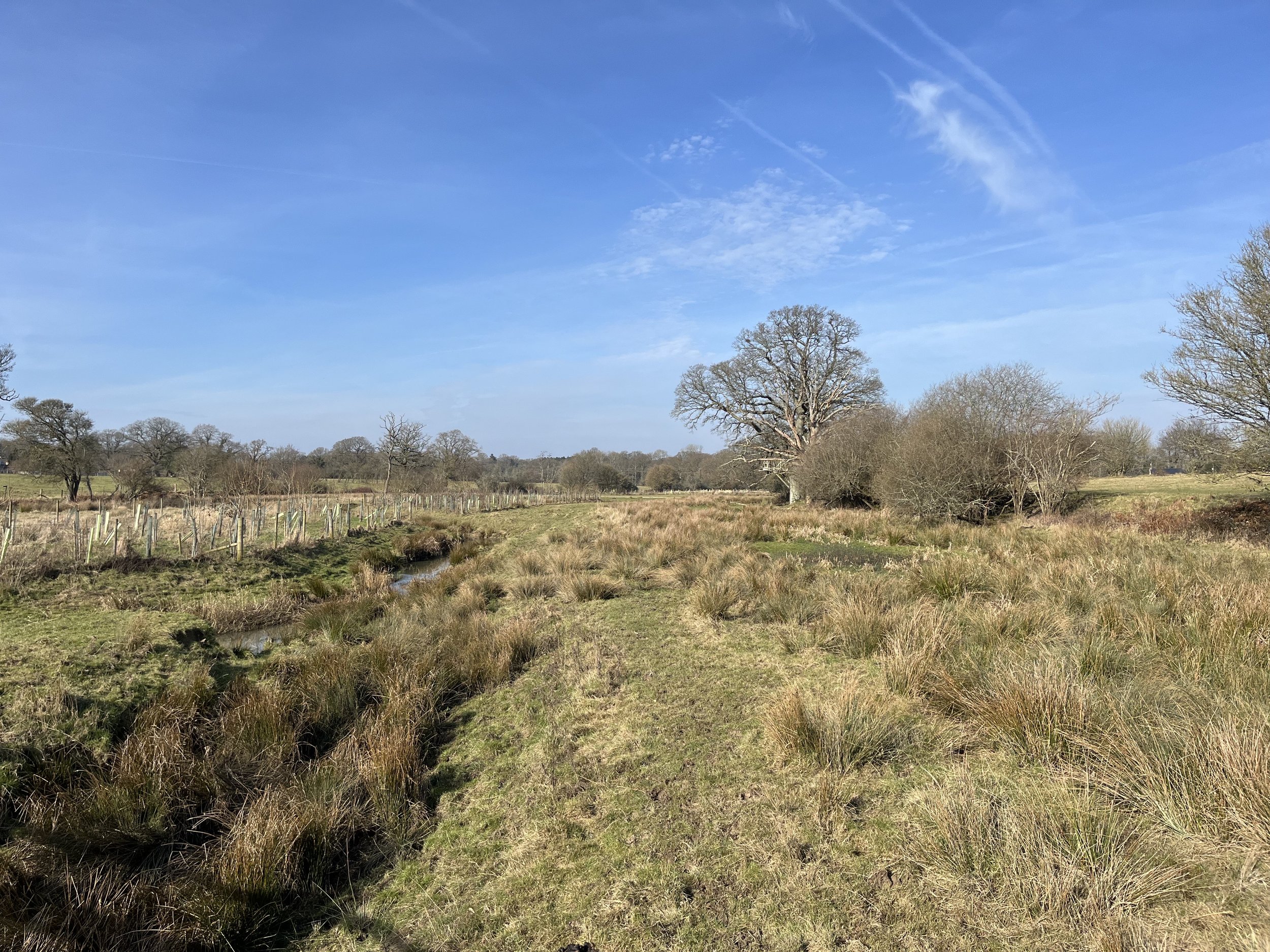
Restored wetland at Knepp
27 Sussex Farms One Step Closer to Realising 30-year Plan for River Recovery
Faced with deteriorating river embankments, twenty-seven farms and estates along the River Adur in West Sussex have reached a milestone in a 30-year plan to recover the river and manage the risk of flooding, after the UK government indicated willingness to allocate £42 million from the Landscape Recovery strand of Defra’s Environmental Land Management Schemes. The group of farmers and landowners will join forces to recover floodplains, wetlands and saltmarsh across 760 hectares from Knepp, the most upstream estate in the project, down to the estuary at Shoreham. The work is projected to improve water quality, boost nature, and mitigate for the impacts of climate change both in regard to flooding and drought.
The project is now working towards an implementation agreement with government. Subject to that, delivery works are planned over nine years and are intended to start in Spring 2027.
Like many rivers across the UK, the River Adur has faced pollution, habitat loss, and rising flood and drought risk. Its aging embankments, originally built as flood defences, have deteriorated and in some places already breached, , along with the infrastructure originally installed to manage the water levels. This results in the farmland behind the embankments becoming waterlogged for many months, impacting income and damaging natural habitats. Along the tidal river, the embankments disconnect the river from the floodplain and trap water on the fields for months.
On some farms, the embankments will be moved back to the edge of the floodplain, so roads and property behind them stay protected while the river and its floodplain are reconnected.
Near Shoreham, arable land that is now too wet to farm will be transformed into saltmarsh which is a natural defence against rising water.
Once complete, the project will re-naturalise more than 25km of river habitat, recover floodplain connectivity across 760 hectares, revive saltmarsh and estuarine mudflats next to the built-up coastal town of Shoreham, helping recover species like Water Vole and Lapwing. Along the South Coast, these habitats are in short supply and provide natural sea defences against increasingly severe weather events.
This is a working, farmed landscape. As floodplains and wetlands recover, they will hold water year round and rebuild the soil health that farm businesses depend on. Most of the land in the project is seasonally grazed, and grazing will continue as an essential part of managing the recovered land.
How It Will Work
The Knepp Wildland Foundation coordinated the project’s three-year development phase.
Around half of the government funding will pay for the capital works, such as moving embankments. Each farmer has a land management plan and will be paid annually for maintaining the land as agreed, with progress checked against a detailed baseline survey. The land will be protected by a conservation covenant for 30 years.
The Benefit To Nature
The Adur connects inland habitats to the sea at Shoreham, where a Site of Special Scientific Interest (SSSI) supports wading birds that feed on the estuary’s mudflats. Further upstream, the river hosts seasonal migrations: sea trout travel up from the sea to spawn, while European eels do the reverse, spending most of their lives in the Adur’s freshwater habitats before heading out to sea to spawn.
Water quality will improve, using wetlands and vegetated floodplain to slow the flow of water and filter out sediment and nutrients.
A more naturally functioning floodplain will hold more sediment on the land, reducing the pollution carried out to sea, which is expected to benefit the restored kelp beds off the coast.
Tristan Price, Interim Director of the Knepp Wildland Foundation which developed and coordinates the project, said:
“This offer is a tribute to the land managers and farmers who have worked hard for three years to get us to this stage.
“The project will mitigate the risk of flooding for those downstream in the face of deteriorating river embankments and the changing climate, while also boosting biodiversity.
“With river health a national priority, the Adur River Recovery Project offers a farmer-led model for improving water quality, restoring habitat and building resilience to a changing climate.
“We now look forward to negotiating the final Implementation Agreement with Defra.”
Melanie Sanders, who leads the project at the Knepp Wildland Foundation, said:
“This is such a fantastic opportunity for the River Adur and all the land managers involved. The land we’re looking at restoring has huge potential for nature and biodiversity and will help to increase the landscapes resilience to the impacts of climate change.”
On top of the government funding, modelling predicts at least £18 million can be gained from the sale of biodiversity units and woodland and saltmarsh carbon credits, taking the total project value to just over £60 million.
Find out more about the Adur River Recovery Project here: https://adur-river-recovery.org/