
Why Infrastructure Needs Dynamic Adaptive Planning Pathways To Make Better Investment Decisions
Infrastructure organisations are operating in a fundamentally different context than they were even a decade ago. Climate impacts are becoming more frequent and severe, while organisations are being asked to decarbonise operations, contribute to nature recovery and maintain reliable services, all at the same time. These pressures increasingly compete for the same capital budgets, assets and decision-makers, creating a challenge that cannot be addressed through separate strategies.
In our previous article, The Future of Transition Planning: Climate, Nature and Resilience in One Strategy, we argued that organisations should stop viewing climate mitigation, adaptation and nature recovery as separate challenges, and instead approach them as part of a wider transition. For infrastructure owners, the question is no longer whether these agendas are connected, but how to make investment decisions that deliver across all three while maintaining reliable, affordable and resilient services.
This big question leads to others:
- Which investments remain effective under different future climate scenarios?
- How do we avoid locking ourselves into costly pathways?
- Where can a single intervention address multiple objectives?
- How do we make decisions when future conditions remain uncertain?
Traditional planning approaches often struggle to answer these questions.
Overinvesting too early can create unnecessary costs, while waiting too long can result in service disruption, asset damage and expensive emergency interventions. The challenge is not simply understanding climate risk. It is deciding when to invest and how much to invest. Major resilience investments made too early can tie up scarce capital, while delaying action can increase maintenance costs, service disruption and asset failures.
Traditional Planning Models: Why They Fall Short
Many infrastructure investments are still based on a single projected future. A climate risk assessment identifies future hazards, a solution is selected and investment follows. But future climate conditions, regulations, technologies and societal expectations remain uncertain.
Overinvesting too early can create unnecessary costs, while waiting too long can result in service disruption, asset damage and expensive emergency interventions. The challenge is not simply understanding climate risk. It is deciding when to invest and how much to invest. Major resilience investments made too early can tie up scarce capital, while delaying action can increase maintenance costs, service disruption and asset failures.
Dynamic adaptive planning pathways help organisations navigate this trade-off by identifying actions that are beneficial today while keeping future options open.
Infrastructure organisations need an approach that supports robust investment decisions across multiple plausible futures.
Dynamic Adaptive Planning Pathways: Planning For Uncertainty Rather Than Predicting It
Dynamic adaptive planning pathways provide a framework for decision-making under uncertainty. Rather than committing to a single long-term solution, organisations identify near-term actions, future decision points and potential intervention pathways that can be implemented as conditions evolve.
This enables organisations to act today while retaining flexibility as climate risks, regulations and investment priorities change.
One of the strengths of dynamic adaptive pathways is their ability to bring together priorities that are often planned separately. Resilience, decarbonisation, nature recovery and asset investment can all be considered within a single decision-making framework.
This helps organisations identify interventions that create value across multiple future scenarios. Nature-based solutions (NbS) are a good example, often contributing to climate resilience, carbon sequestration, biodiversity enhancement and wider social value simultaneously. When incorporated within an dynamic adaptive pathway, they can help maximise investment value while retaining flexibility for future adaptation. This is where climate transition planning becomes essential. At Accelar, we help infrastructure organisations translate climate risk into investment-ready transition plans that integrate resilience, decarbonisation, nature recovery and asset management objectives.
Through our work supporting infrastructure, public sector and landscape-scale nature recovery programmes, we have seen that organisations achieve better outcomes when these priorities are planned together rather than through separate strategies.
Why Dynamic Adaptive Planning Pathways Matter Now
Many infrastructure organisations already understand their climate risks. The challenge is converting that understanding into practical, investable action.
Dynamic adaptive pathways bridge this gap by linking climate risk to investment decision-making. They help organisations prioritise near-term actions, align resilience measures with asset renewal programmes and create a transparent framework for future investment decisions.
In an environment of increasing climate uncertainty and constrained budgets, this can reduce the risk of both underinvestment and maladaptation.
At Accelar, we help infrastructure organisations translate climate risk into investment-ready transition plans that integrate resilience, decarbonisation, nature recovery and asset management objectives.
Through our work supporting infrastructure, public sector and landscape-scale nature recovery programmes, we have seen that organisations achieve better outcomes when these priorities are planned together rather than through separate strategies.
A Practical Example: Flood Resilience In The Rail Sector
The UK's rail network illustrates the challenges of planning in the face of uncertainty well.
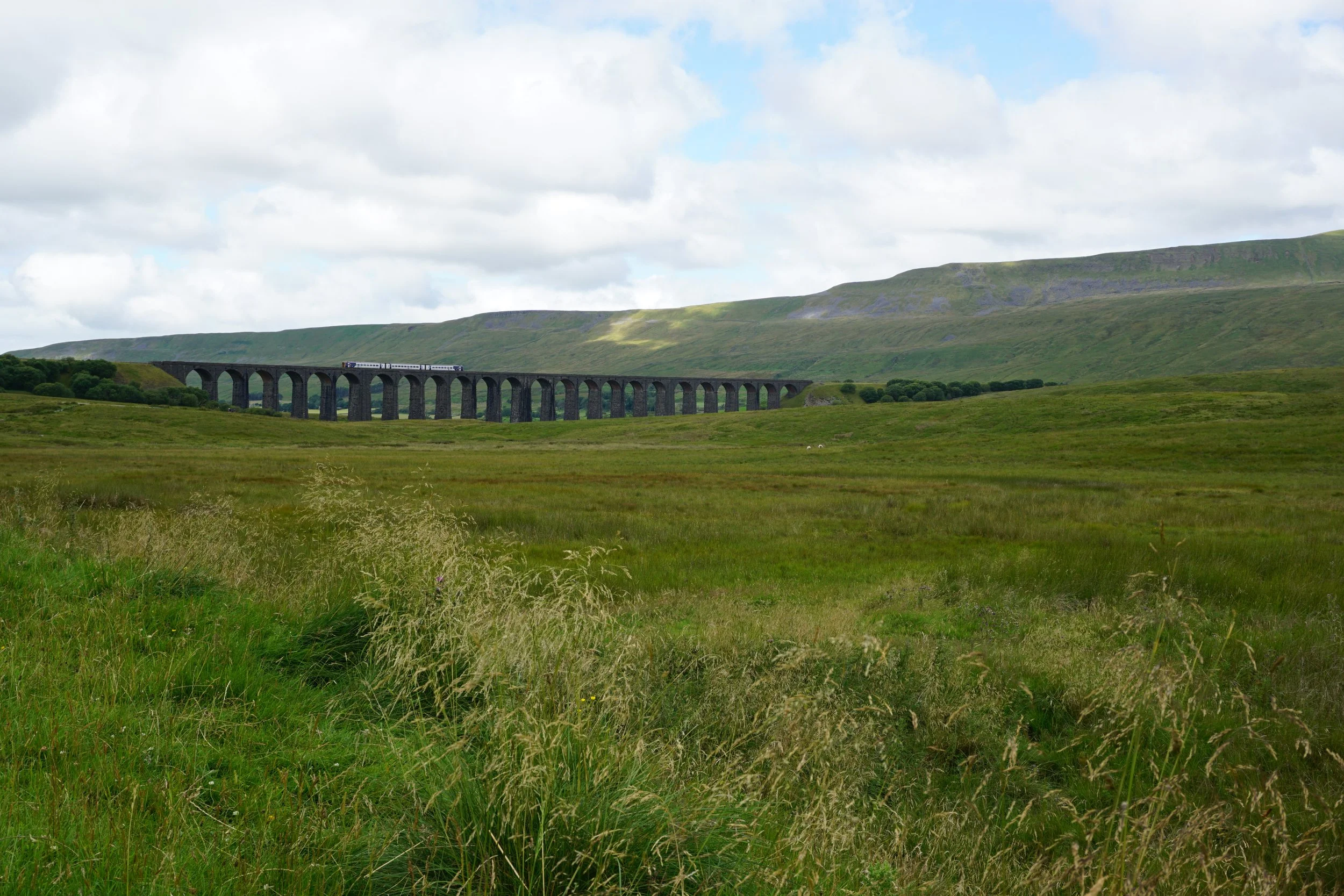
Rail operators face increasing risks from flooding, extreme heat, landslides and erosion. Network Rail states that climate change is one of the biggest challenges facing the railway today and that unprecedented rainfall, storms and heatwaves in recent years have already impacted railway operations. During the 2022 heatwave, the impacts on Network Rail assets were significant enough to prompt the establishment of an expert resilience taskforce to review how the network could adapt to more frequent extreme heat events.
Consider a railway operator facing increasing flood risk along a section of track.
The Traditional Approach
Using a single climate projection and design standard, the operator may decide to construct a major engineered flood defence today. This could involve raising embankments, constructing flood walls, enlarging culverts and upgrading drainage infrastructure to protect against a specific flood scenario.
While this approach may provide a high level of protection, it requires significant upfront investment and is based on assumptions about future climate conditions, service requirements and risk tolerances that could change over time. If flood risk increases more rapidly than expected, the design may prove insufficient. If flood risk increases more slowly, the investment may be larger than necessary.
The Dynamic Adaptive Planning Pathways Approach
While dynamic adaptive planning pathways originated in flood and water management, they are increasingly being applied across infrastructure portfolios to support long-term investment planning under uncertainty.
Rather than committing to a single large intervention, the railway operator could develop a pathway that responds to how risk evolves over time. Initial actions could include:
Improved rainfall, river-level and asset-condition monitoring
Enhanced drainage maintenance and targeted drainage upgrades
Restoration of upstream catchments and floodplain habitats to help slow and store runoff
Identification of critical assets and failure thresholds
Integration of flood resilience objectives into asset renewal programmes
At the same time, decision triggers might be established, such as:
A defined number of flooding incidents within a given period
Increasing maintenance costs associated with flood damage
Exceedance of agreed service disruption thresholds
Updated climate projections indicating materially higher risk
If trigger points are reached, the operator can progressively implement further interventions, ranging from larger drainage upgrades through to major engineered flood defences as required. Crucially, these decisions can be aligned with asset replacement cycles, available funding, decarbonisation objectives and evolving regulatory requirements.
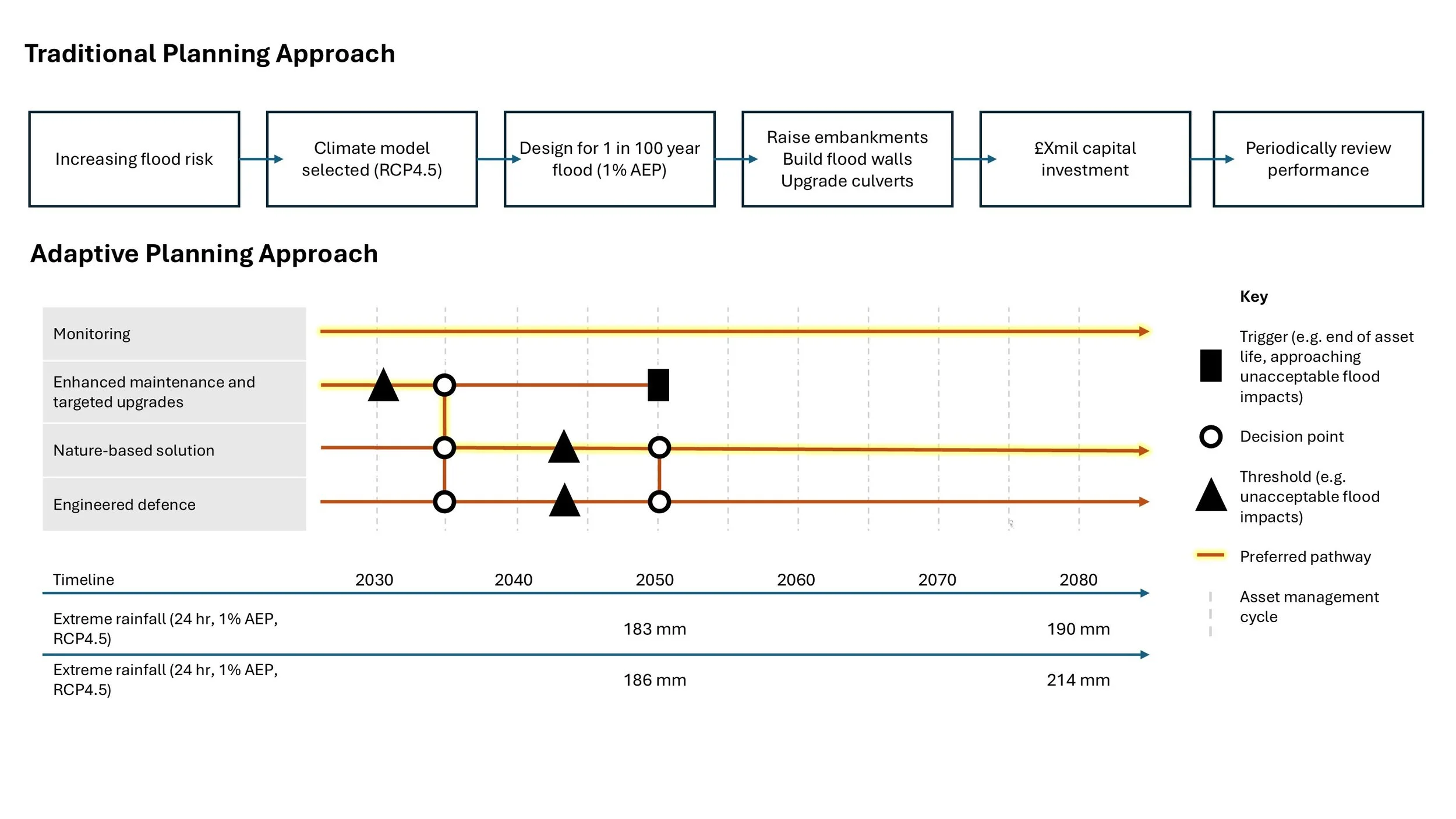
Traditional vs Dynamic Adaptive Planning Approaches.*
*Note this diagram is designed to provide an indicative example and is not to be used for implementation.
From Climate Risk To Climate Transition
Traditional infrastructure planning often assumes that future conditions can be forecast with reasonable confidence. Climate change challenges that assumption.
Dynamic adaptive planning pathways help infrastructure organisations move from understanding climate risk to making robust investment decisions. By linking climate risk, resilience, decarbonisation, nature recovery and asset planning within a single framework, they provide a practical foundation for climate transition planning.
For infrastructure owners and operators, this offers an opportunity to move beyond separate adaptation, net zero and nature strategies towards a more integrated approach to climate transition.
At Accelar, we use dynamic adaptive planning pathways as part of a wider climate transition planning approach, helping infrastructure organisations translate climate risk into practical investment strategies that integrate resilience, decarbonisation, nature recovery and asset management objectives.
To find out more about how we can support your organisation, take a look at our climate transition services or get in touch today via info@accelar.co.uk.
Key Takeaway
What three questions should infrastructure organisations be asking?
Which climate risks could fundamentally affect service delivery?
Which investments create value across multiple future scenarios?
Where could nature-based solutions strengthen resilience while supporting wider transition objectives?